Monday, 14 May 2018

The Explanatory Power of Thomist Aesthetics

One way to judge a theory is by its explanatory power. A theory that is able to account for more of the relevant phenomena is prima facie better than its rivals. In this short article I would like to bring to your attention the strong explanatory power of Thomist aesthetics, an area often overlooked by both popular and professional Thomists. One of the typical problems that aesthetic theories run into is not being able to adequately account for different types of art. Specifically, many theories of art account for classical or realistic art, while failing to comprehend modernist art or vice versa.

Before I begin, let me explain the fundamental idea behind Thomist aesthetics. According to Thomism unity, goodness, truth, and beauty are all transcendentals. Roughly, this means that wherever we find being, we also find unity, goodness, truth, and beauty, because all of these concepts point to one aspect of the notion of being. Thomist aesthetics, unlike other theories, begins with being, and not with a formalized and restrictive definition of beauty or art.

The naive aesthetic theory that I will call “realism” holds that art is an imitation of something real. This makes sense when looking at much of classical art and the history of painting, but utterly fails to explain why an impressionist or expressionist painting (by Claude Monet and Julius Evola, respectively) is considered good, despite that fact that art from the impressionist and early expressionist periods is almost universally loved by non-specialists. Similarly, a popular theory by Arthur Danto, often called “institutionalism” claims that art is whatever artists, galleries, and art-institutions can get away with calling 'art'. This definition seems to bypass the problem we are discussing, namely being able to comprehend a variety of different art styles, but it does so by ignoring the problem, not by answering it. This answer is unsatisfactory, because we want to know why some art seems good, beautiful, or satisfying, while other art does not. These two trends of realism and institutionalism represent most attempts at aesthetic theorizing. Theories that tend towards realism look for some objective feature of art that relates to the world, and all art can then be judged by whatever standard is put forward as the essence of art. Theories that tend towards institutionalism make all aesthetic judgment subjective by saying art is merely a sociological category, or is merely the cause of a subjective emotional response. Thomist aesthetics finds the middle road between these two paths by pointing to being as the foundation of beauty. By recognizing that beauty is an inherent aspect of being, Thomists can make sense of classical realistic art, an impressionist painting, and an abstract expressionist painting.

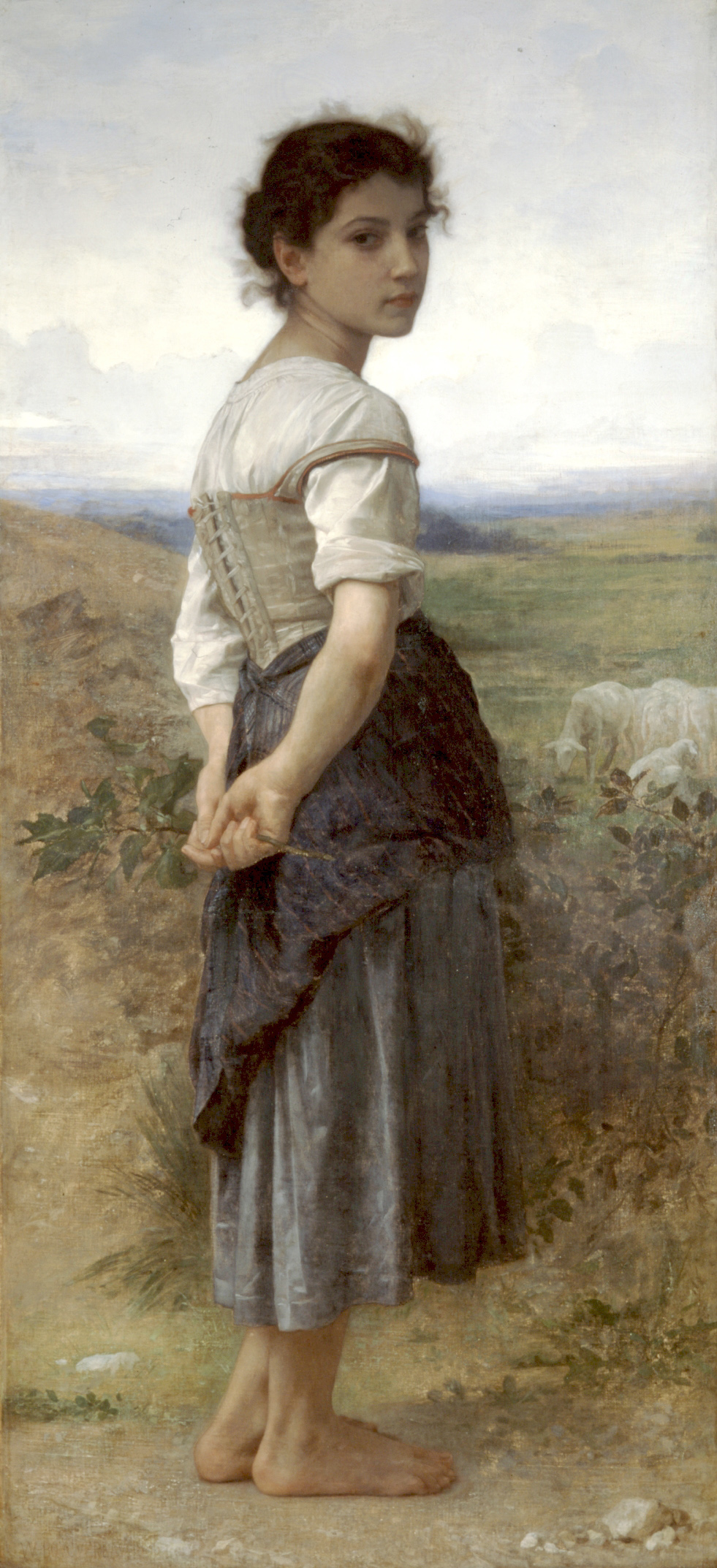
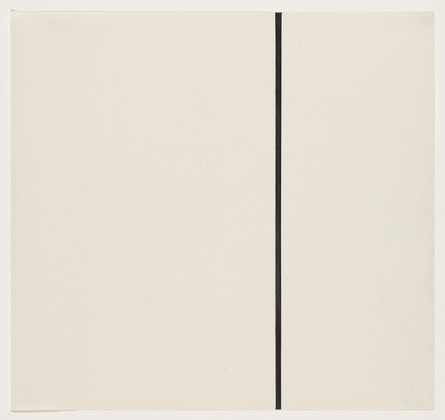
In a realistic painting or a portrait, a clear depiction of an object or person is the being dsplayed. For example, a young shepherdess is the subject of this painting by William Adolphe Bouguereau, and it is her beauty that is grasped, through her being, when we see the painting. In an impressionistic painting, like this one by Erin Hanson, what is portrayed is a subjective impression of some scene or object. According to Thomism, however, our feelings, emotions, and experiences all have being, and it is this being that is displayed in impressionist paintings. We can follow this logic even further to make sense of an abstract painting that consists two red and blue triangles, or even a painting consisting of one single black line, both by artist Ellsworth Kelly. Triangles and lines have a type of being (often called 'conceptual being' by Thomists), although it is not the exact type of being encountered in physical reality. In abstract paintings like these what is being displayed is the conceptual being of abstract objects contemplated in our minds. The beauty of modern art consists of the beauty contained in conceptual being. It may even be useful to think of the beauty of modern abstract art as more akin to the beauty one finds in the truth of a well-formed, true syllogism or a mathematical formula than to the beauty of a realistic portrait. But no matter how we think of it, it is beauty nonetheless.

Whatever its other virtues or vices as a theory, Thomist aesthetic theory manages to explain a vast array of different types of art, and for this reason alone it should be considered a strong and interesting theory, well worth the time of those looking into aesthetics.

Monday, 30 April 2018

The Regularity Theory of Causation

I'm sometimes told that the regularity theory of causation dominates Anglo philosophy. That isn't, however, true. The regularity theory fell out of favor in the '70s. You can learn more here.

Tuesday, 24 April 2018

A Skeptical Thought Experiment

Consider the following thought experiment:

An angel shows himself to you. In his hands he holds a book containing every true proposition. Nothing is left out, and nothing can ever be added to the set of propositions contained therein. The book is not to be had for free. In exchange, you must give up something dear. You may give up your ability to perceive beauty—for the rest of your life Beethoven will be indistinguishable from vicious animals growling at one another. You may give up the use of all four of your limbs. You may give up your emotional and sexual health, leaving you a sad, lonely person with unnatural and despicable urges. You may give up the ability to ever feel human love again.

Confronting you is the question of the value of truth. Traditionally, philosophers have claimed the highest value for truth, placing it above all else. But if you had to make the choice between truth and some other valuable thing in life, would you really choose truth? Not everyone would agree that truths can be found in propositions like this. For example, a pragmatist may say that truths are embodied in functional processes. A Platonist or Christian may assert that truth is something lived or conformed to through the virtues and the intellect. But surely, the ambiguous nature of truth cannot be used to argue in favor of its supreme value. Upon inspection it would seems that the propositionalist, the pragmatist, and the Platonist are actually talking about different things, despite all using the word 'truth'.

For modern man, however, truth is conceived primarily as proposition. A true proposition is one that accurately corresponds to reality, or accurately reflects reality. These are the sorts of propositions that are largely taught in schools. These are the sorts of propositions that scientists seek to lay down in systems called theories. These are the sorts of propositions that we call facts. How important are true propositions to you, and how do they compare to the other valuable things in your life?

For further reflections on this topic, see Nietzsche's On Truth and Lie in an Extra-Moral Sense, one of Nietzsche's pieces which inspired this thought experiment.

Saturday, 21 April 2018

An Introduction to Tropes

Since they have cropped up in a number of discussions before and arguably form an indispensable part of the metaphysics of 'Classical Realism', Scholastic Realism very much included, I thought it would be worth doing an all-round intro post on the subject of tropes. First of all a terminological distinction: the term 'tropes' and 'property-instance' will be used synonymous throughout this post, though the former is often used in the context of a certain kind of Nominalism it is in fact neutral as to whether one also includes universals in one's ontology. The term property-instance on the other hand might imply a realist commitment with said entities being instances of something above them. The phenomenologically inclined will of course also recognize tropes/property-instances as being equivalent to Husserl's 'moments'.

Tuesday, 17 April 2018

Could a Child Refute Eliminativism?

I was going to write an argument, inspired by one of Lycan's, against eliminativism. It, however, looks like Lycan himself beat me to it (with comments by Vallicella here).

Saturday, 14 April 2018

FAQ: Substances and the Problem of Individuation

Another FAQ from the reading group. I was fond of apples at the time:
What is a substance?

A substance is something that bears properties but is not itself borne by anything else.

What's the difference between a substance-attribute theorist and a bundle theorist?

Substance-attribute theorists think a flower an irreducible-substance-instantiating-properties; bundle theorists, nothing more than a unity of properties. Substance-attribute theorists think there are irreducible substances; bundle theorists, that they're reducible to bundles of universals or tropes.

(Technical note: Having written this, there is a sense in which some bundle theorists substantialize first-order properties so those properties can themselves have properties.)

What is the Problem of Individuation?

Moreland writes:

To clarify . . ., recall Socrates and Plato, two red, round spots that share all their pure properties in common. The problem of individuation is the problem of offering an ontological [account] of the situation so as to specify what it is that makes the two red spots two particular, individual entities instead of one. (Universals)

Most people would use two red apples, not dots.